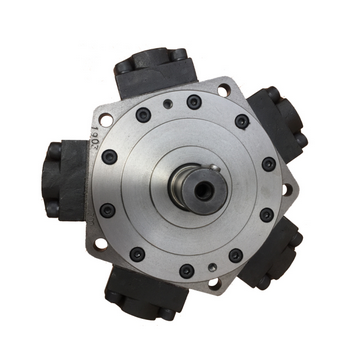
The YCM hydraulic motor has high housing strength and strong load-bearing capacity of internal dynamic components, with a wide continuous power range. The main features of the motor are as follows:
Adopts a crankshaft and a five-cylinder, five-piston mechanism with low excitation frequency, maintaining the original low-noise characteristic;
Has a large starting torque and excellent low-speed stability, enabling stable operation at very low speeds;
Utilizes a planar compensable oil distribution structure, which offers high reliability, low leakage, and convenient maintenance. The piston and plunger sleeve are sealed with sealing rings, ensuring high volumetric efficiency;
The crankshaft and connecting rod are supported by rollers, providing high mechanical efficiency; the rotation direction is reversible, and the output shaft can withstand a certain degree of radial and axial external forces.
What Categories Can Common Hydraulic Motors Be Divided Into?
Classified by structure, they include vane hydraulic motors, gear hydraulic motors, and low-speed piston hydraulic motors. They can also be divided into low-speed motors and high-speed motors. Additionally, they can be categorized into gerotor motors, internal five-star motors, external five-star motors, ball motors, and so on.
How to Select Among So Many Series of Hydraulic Motors?
The basic parameters of a hydraulic motor include working pressure, flow rate, displacement, and power. The most crucial factor is to determine the required power based on the customer’s needs, which must match the hydraulic pump in use.
The method for selecting the displacement can also be calculated as follows:V = Q (system flow rate) / n (required motor speed)
Then, select the model based on the displacement, refer to the product specifications, and for imported hydraulic motors, check whether the motor’s torque meets the requirements.
Gerotor Hydraulic Motors (One Series of Hydraulic Motors)
Even at very low speeds, the output shaft of a gerotor hydraulic motor can produce stable output. By changing the direction of the input/output (I/O) flow rate, the motor can reverse direction quickly and generate torque of equal value in both directions.
Additional Note
In fact, each series of motors offers a variety of displacement options to meet the requirements for different speeds and torques. We hope customers will not make a wrong selection!!